Yes, if you ask and IMT (the national transport authority, Instituto da Mobilidade e dos Transportes) approves. The exame de código (the theory test) is set in Portuguese, but you can ask for the theory paper to be translated into another language, English included. It is not an option you pick on screen on the day of the exam: you make the request beforehand, through your escola de condução (driving school), and a translator registered with IMT does the translation.
If you are deaf, you can also ask for a sign language interpreter during the test.
What the law says
The rule is in the Regulamento da Habilitação Legal para Conduzir (the regulation on the legal requirements to drive, RHLC), which sets the rules for getting a licence. Translation of the theory test has been provided for since the RHLC was approved in 2012. Under the current wording, introduced by the June 2026 decree-law, IMT can authorise translation if you ask in writing (a requerimento) and two conditions are met:
- you have proven an insufficient command of Portuguese, liable to compromise your understanding of the exam;
- it is possible to guarantee that the translated test is materially equivalent to the Portuguese one.
Before this change, translation was only provided for categories AM, A1, A2, A, B1 and B (the motorbike and car categories). Decree-Law 114/2026 of 8 June 2026 says it extends translation of theory tests to all categories. The change takes effect 30 days after publication, that is, from July 2026.
The government’s guide to getting a licence (gov.pt) still showed the old list of categories on 25 October 2026. For a car or motorbike licence there is no doubt. For a lorry or bus licence, your school can tell you how the exam centre (centro de exames) is applying the change.
The same rule guarantees that a deaf candidate can ask for an accredited sign language interpreter to be present during the test.
How to request a translated test
The procedure is set out in a deliberação, a decision of IMT’s board, dated 9 September 2020, which is still published on IMT’s exam tests page. IMT itself, in its frequently asked questions, tells you to sort this out with your driving school. The steps are these:
- You tell your school that you want to take the theory test with a translator. The government guide advises making this request when you enrol, if you also want your training in English.
- The school, when it asks the exam centre for your test, names the translator.
- The exam centre sends the request to IMT with your details, the day and time you want, the translator and the language.
- IMT generates a Multibanco payment reference for the fee, which has to be paid no later than the day before the test.
Translators have to be registered with IMT, with a document proving their status as a translator issued by consular services or by a translators’ association. The 2026 list that IMT publishes includes, among others, English, French, Spanish, German, Russian, Ukrainian, Romanian, Arabic, Mandarin, Bengali and Persian.
There are fewer slots than for a normal test. According to the decision, tests with a translator are held on Tuesdays and Wednesdays from 9am to 11am, and on Thursdays from 2pm to 4pm. Each exam centre holds a maximum of 4 translated tests per session. Allow for this when you plan your dates.
A translator is not an interpreter sitting next to you. Under the decision, the translator receives the test in Portuguese, has two hours to translate it in writing and returns it to IMT, which generates the translated test and sends it to the exam centre. It is not someone who goes in with you and reads you the questions, and the law does not provide for you to bring a friend who speaks both languages.
What if reading is a struggle?
The RHLC does not provide for an oral test or for reading aloud for the car and motorbike categories. The theory test is a multimedia test in which you answer by tapping the screen.
The only exception we found in the regulation is the licence for agricultural vehicles in category T of type I: motor cultivators (motocultivadores) with a trailer or retrotrem (rear trailer unit), and tratocarros (tractor-carriers), provided the maximum mass of the combination does not exceed 2,500 kg. The exam for that licence is a practical test with an oral questionnaire.
If reading is an obstacle, talk to the school before you enrol and ask it to confirm with IMT what is possible in your case.
If you already hold a driving licence from another country, you may not need to take any exams: IMT has a page of its own on exchanging a foreign driving licence (troca de título de condução estrangeiro).
The vocabulary that trips people up
Even with a translated test, the lessons, the signs with text and the Código da Estrada (the Highway Code) are in Portuguese. These are the words that usually confuse people who learned to drive in another language. The English translations are ours, to help you find your way, and are not official translations.
| Portuguese | English | What to know |
|---|---|---|
| ceder a passagem / cedência de passagem | give way, yield | Slow down or stop to let another vehicle through |
| prioridade | right of way | Whoever has it still has to be careful |
| faixa de rodagem | carriageway, roadway | The part of the road meant for vehicle traffic |
| via de trânsito | lane | Part of the carriageway for a single line of vehicles |
| berma | shoulder, verge | Runs alongside the carriageway and is not specifically meant for vehicle traffic |
| passeio | pavement, sidewalk | Meant for pedestrians |
| via de aceleração | acceleration lane | To gain speed before you join the road |
| via de abrandamento | deceleration lane | To slow down clear of the main traffic before you exit |
| cruzamento | crossroads, intersection | Roads that cross at the same level |
| cruzamento de veículos | meeting oncoming traffic | Not a crossroads: it is passing a vehicle going in the opposite direction |
| entroncamento | junction, T-junction, fork | A joining or forking of roads |
| rotunda | roundabout | |
| localidade | built-up area | Starts and ends where the signs say |
| ligeiro / pesado | light / heavy vehicle | Light: gross weight (peso bruto) up to 3,500 kg and up to 9 seats, driver included |
| paragem | stopping | Only for as long as passengers get in or out, or for brief loading and unloading |
| estacionamento | parking | Leaving the vehicle stationary when it is neither stopping nor held up by traffic (such as waiting at a red light) |
| ultrapassagem | overtaking | |
| marcha atrás | reversing | |
| mudança de direção | turning | |
| passagem de nível | level crossing | A place where the road crosses the railway line at the same level |
| contraordenação leve / grave / muito grave | minor / serious / very serious traffic offence | Minor carries only a fine; serious and very serious also carry an additional penalty |
| coima | fine | |
| inibição de conduzir | driving ban | The additional penalty for serious and very serious offences |
The definitions of verge, carriageway, lane, acceleration and deceleration lanes, crossroads, junction, built-up area, light and heavy vehicle, stopping and parking, and the types of offence (contraordenação, an infringement punished with a coima, a fine) all come from the Highway Code.
Pay attention to the names of the signs too. Many use these words, and memorising the name helps you recognise the vocabulary in the questions.
-
 B1 Cedência de passagem
-
 B2 Paragem obrigatória no cruzamento ou entroncamento
-
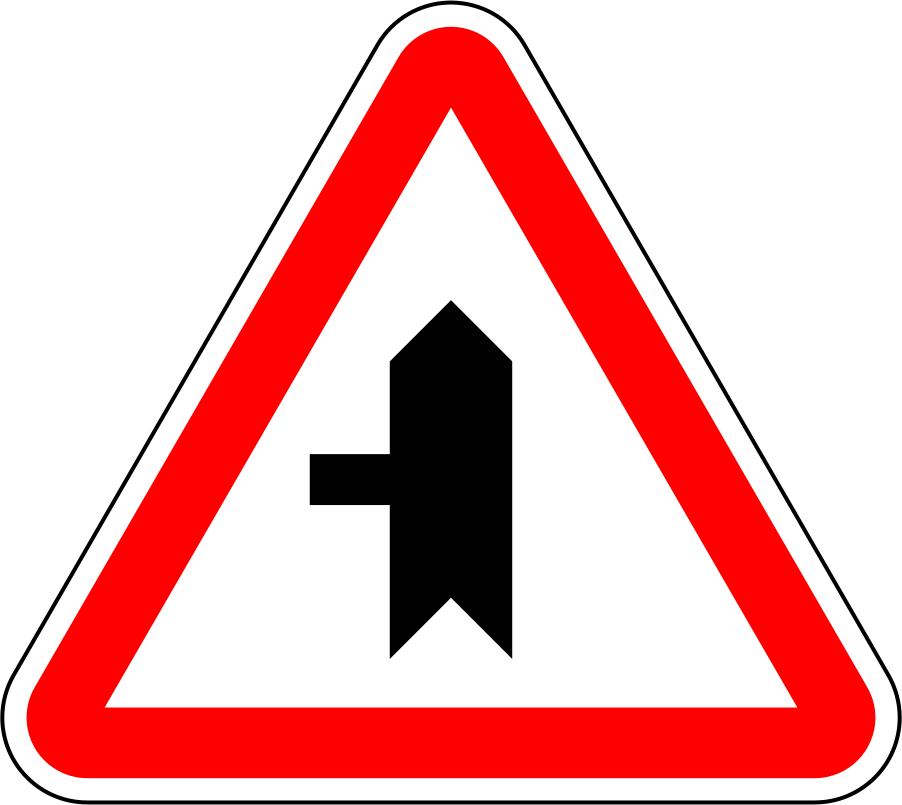 B9a Entroncamento com via sem prioridade
How to study when Portuguese is not your first language
Start with the signs. They are drawings and colours, so they hardly depend on language. Learn them first, with the Portuguese name next to each. You can practise them in the road sign list on Via Rápida (in Portuguese). If you mix up signs that look almost the same, there is an article on Portuguese road signs that look alike.
Build your own glossary by topic. When you study speed, giving way or parking, note down the new words for that topic. Review ten words at a time, not a hundred.
Practise the questions in the language you will sit the exam in. If you are going to take the test in Portuguese, practise in Portuguese from the start, even if at first you use a machine translator to understand the explanations. If you are going to take the translated test, still learn the Portuguese terms: the test is translated by a translator and may not use exactly the words you studied.
Read each question twice. Small words change the answer: exceto (except), salvo (except, save for), apenas (only), sempre (always), nunca (never), é permitido (is allowed), é obrigatório (is compulsory). One word read in a hurry is enough to get wrong a question you knew. The most frequent misreadings are collected in common mistakes in the Portuguese theory test.
Choose the school for its language too. Before you enrol, ask whether they teach in English (or in your language) and whether they have already handled tests with a translator. A school that has already made the request knows how long it takes to get a slot.
Do full tests. Once you have the vocabulary, do theory tests (in Portuguese) from start to finish, with no translator app open. That is how you find out whether you can already read the questions at the speed you need.